In a world where online visibility is crucial to your digital strategy, Google paid search (Search Engine Advertising, or SEA) is one of the most powerful levers for capturing your audience’s attention and propelling your business.
But be warned: the adventure comes with its challenges! Between budget management, campaign optimisation and real-time adjustments, paid search with Google Ads can look complicated. Don’t panic: we’ll walk you through the winning strategies and the mistakes to avoid, with a bit of humour and plenty of practical advice.
Ready to boost your performance and dominate the search results? Read on!
Why has Google Ads become unavoidable?
The rise of online advertising: a global phenomenon
You can’t escape it any more: online advertising is everywhere. What’s really remarkable is that it has become a pillar of the digital economy. Everyone has a smartphone in their pocket, everyone goes online every day, and almost everyone searches on Google.
You can see where we’re going, can’t you? If you run a business, that’s where it all happens. And in a digital world where every click counts, a paid search campaign with Google Ads (paid advertising via Google) is a real playing field where everybody wants to score points. If you’re not there yet, well… it’s high time you got started!
Google Ads: the tool that changes the game
So why has Google Ads become the must-have tool for businesses running paid search? Simply because it lets your brand shoot straight to the top of Google’s search results. Yes, right there, in the first positions, where everybody looks.
Don’t want to get lost in the flood of organic listings? Paid search gives you the chance to be visible instantly. And as we all know, being visible is already half the battle in the jungle of digital marketing.
With a Google Ads paid search campaign, not only do you get the advantage of showing up first, you also get a global reach. You don’t just reach users near you, but a whole universe of potential web users and therefore traffic. It’s a bit like having a digital supermarket, where every aisle is carefully placed to lead the customer exactly where you want them.
Decoding Google Ads with a bit of humour, but a lot of know-how!
You’ve got the idea: paid search with Google Ads is the secret weapon every business should have in its marketing arsenal to boost its website and its reputation. But, spoiler alert: understanding how a campaign works can sometimes feel like solving a Rubik’s cube upside down.
Don’t panic, we’re here to guide you through the maze with a smile and a touch of humour. The goal? To decode Google Ads and help you discover its subtleties so that you, too, can boost your performance without getting lost along the way. Right, off we go!
Google Ads and paid search: what are they, exactly?
Definition of SEA (paid search) and Google Ads
SEA stands for Search Engine Advertising, which is simply paid advertising on Google (also known as paid search or PPC). When you search for a product or service, you’ve probably noticed that at the top of the results there’s a small “Ad” label just before the title.
These are the Google paid search ads. In short, you pay for your ad to appear whenever a user types a keyword related to your business.
Google Ads is the tool Google gives you to manage advertising for your website. You bid on specific keywords, and if your bid is competitive enough and your ad is relevant, it appears in the search results. It sounds simple, but there are a few subtleties that we’ll go through together to build a good paid search campaign.
The difference with SEO (sorry, no confusion allowed here!)
Let’s clear up any confusion right away: paid search and SEO (Search Engine Optimisation) are two very different things. SEO, or organic search, is a long-term effort to optimise your site so it climbs the organic results on Google (without paying), whereas paid search is the “paid” side of digital marketing.
In other words, with SEO you work to build free, long-term visibility, while paid search gives you immediate visibility, but in the form of advertising. It’s not a question of good or bad, just of strategy. And ideally, you combine both to own the results page and generate traffic!
The basics: how does Google Ads work?
So how does it work in practice? At its core, Google Ads is based on an auction system. You choose a keyword relevant to your business and state how much you’re willing to pay each time a user clicks on your ad (this is called CPC, or cost per click).
Google then compares your bid with those of other advertisers using the same keywords. If your bid is competitive enough, and your ad meets Google’s criteria, it will appear at the top of the results. A bit of strategy, a bit of magic, and presto, there you are in front of web users!
How bidding works
Bidding is the central element of Google Ads. Unlike a traditional auction, where you bid on objects or services, here you bid on keywords. You set a daily budget, a maximum you’re willing to pay for each click, and an overall cap on your campaign.
Once all that is in place, Google takes into account your bids as well as other factors (such as ad relevance and landing page quality) to decide the order in which ads are displayed. The more you’re willing to pay, the more likely you are to appear at the top.
But beware: it’s not a simple game of “the more I put in, the more I win”, because the quality of your ad also plays an important role.
The role of Quality Score in ad performance
Quality Score is a bit like the secret criterion that lets some ads reach the top of the results without having spent a fortune on bids. Google gives each ad a Quality Score, based on the relevance of your keywords, the quality of your landing page, and the user experience in general.
If your ad is well written, your site is fast and optimised, and your message matches what the user searched for, you’ll get a good Quality Score. That lets you lower your costs while still getting good results. In short, Quality Score rewards advertisers who offer a quality experience to their users, which is rather good news, isn’t it?
With these basics, you’re already well on your way to understanding how Google paid search works. Now let’s see how to put it into practice!
Why start with Google Ads paid search?
Paid search: a growth lever for businesses
You’ve probably noticed it: more and more businesses are launching paid search campaigns on Google. But why? Because it’s no longer just a trend, it has become a genuine growth lever.
We’re talking about immediate visibility, results measurable in real time, with clear and trackable goals, and the ability to adjust your strategy as you go. Paid search is a bit like the performance booster of digital marketing.
No time wasted waiting months to find out whether your SEO efforts are paying off: with paid search, the results are there straight away, and you can adjust your strategy live. In short, it’s the shortcut to glory… or, at least, to visibility on search engines through advertising.
The instant visibility of paid search
The first reason to start with Google Ads is instant visibility. Yes, you heard right: instant. With the right campaign strategy, in a few clicks you’re at the very top of the search results, ready to capture your audience’s attention.
No need to wait weeks or months for your site to climb in SEO. You bid, and boom, there you are in the first results. For a business looking to get known and build its reputation, it’s a guarantee of immediate visibility, especially if your market is very competitive on your target. In other words, if you want to shine quickly, Google Ads is your friend!
Real-time performance measurement
One of the strengths of paid search with Google Ads is that it lets you measure your campaign performance precisely, in real time. You can see exactly how much you’re spending, how much you’re earning, and adjust your strategy accordingly.
Need more clicks? Raise your bid. Fewer conversions?
Work on your ads or your keywords. With Google Ads, everything is measurable, everything is adjustable, and you can optimise your campaigns down to the second to better reach your target. You have the power to change things in real time, which is a real advantage in a digital world where responsiveness is the key to an effective website.
The advantages of Google Ads
Of course, Google Ads isn’t just about visibility and measurement. There are also plenty of other advantages to using it in your marketing campaigns. First, you get total flexibility.
You set your budget, your bids, your keywords, and even the duration of your campaigns. You also have absolute control over every aspect of the campaign, whether it’s when it appears, the type of audience targeted, or even the way you want your ad to look. And that’s gold for the modern marketer who likes to hold the reins.
Flexibility and full control of the campaign
Paid search offers unrivalled flexibility. You can change your campaigns at any time, test different strategies, adjust your daily budget and even specify the days and hours when you want your ads to run.
You are the master of your campaigns and you have total control. You decide which way to go, and that is precisely what makes Google Ads so powerful.
Ultra-precise targeting: the modern marketer’s dream
This is where Google Ads really stands out from other forms of advertising: creating a campaign that reaches your target web users. You can target ultra-precise segments of your audience, using criteria such as keywords, location, search history, age, interests, and even the time of day.
In other words, you speak directly to the people who need your products or services, at the moment they need them. If you’re a marketer, you’re probably dreaming about this targeting ability and about generating the right leads. No more scattering ads everywhere and hoping they land on the right person!
Common mistakes to avoid (and how not to mess up!)
Of course, as in any marketing strategy, there are pitfalls to avoid (poorly managed budget, useless clicks, and so on). One of the most common mistakes is poor budget management. Sometimes you set too small a budget and tell yourself “I’ll just test it”.
The result? The ad doesn’t run enough to get meaningful clicks. Conversely, some people launch with a budget that’s too big, but fail to target their audience properly, which generates useless clicks.
Clicks cost money, so every click should be a considered investment. You need to track your spending closely and adjust your bids to get a good return on investment (ROI). The secret is to find a balance. But don’t worry, we’ll explain how to avoid messing it up.
Since we’re a really nice agency, we’ve put together a whole tutorial on the mistakes to avoid at the end of this article.
Creating a Google Ads campaign: child’s play (almost!)
The structure of a Google Ads campaign: decoded
Creating a Google Ads campaign for paid search can seem daunting at first, but once you understand the basic structure, it becomes child’s play (almost). In Google Ads, everything starts with a campaign. It’s the top level, the one that groups your goals and your budget.
Once your campaign is created, you divide it into ad groups. Each group corresponds to a set of similar keywords and ads. Inside each group, you create the ads that will appear in the search results.
This hierarchy may look basic, but beware: the whole secret lies in how you structure your campaigns and ad groups. The more organised you are, the better your chances of success.
Choosing your keywords: a mix of intuition and data
Choosing the right keywords is an art. On one hand, you need to draw on your intuition and knowledge of the market, but on the other, you need to rely on hard data. The keywords you choose determine who your ad will be shown to, so it’s crucial to choose them well.
Using tools like Google’s Keyword Planner can help you refine your selection by showing you search volumes and competition for each keyword. And don’t underestimate the long tail: these very specific (and often less searched) phrases can turn out to be goldmines, because they’re less competitive and often more profitable.
How to find the right keywords (with or without a magic tool)
Finding the right keywords isn’t an exact science, but several techniques will help you put the odds in your favour. You can start by thinking about the keywords your potential customers use. Beyond that, there are powerful tools that can help you refine your research, such as Google Keyword Planner, SEMrush or Ahrefs.
These tools give you valuable information on search volumes, competitiveness and even suggestions for related keywords. There’s no magic tool to guarantee success, but they will get you closer to perfection.
The importance of the long tail: a secret strategy?
The long tail is a concept every good paid search marketer should know. It refers to very specific keywords, often longer than general terms.
For example, instead of targeting “sports shoes”, you could go for “women’s running shoes size 5”. These keywords generate less traffic, but they’re often cheaper and, above all, they attract a much more qualified audience. It’s a secret strategy for targeting better and not wasting your budget.
Ad extensions: a little bonus to boost your ads
Ad extensions are like little bonuses that complete your ads and make them even more attractive. They let you add extra information, such as sitelinks to other pages of your site, phone numbers so people can contact you directly, or your physical address if you’re a local shop.
These extensions give your ads more visibility and can even improve your Quality Score. In short, it’s a small boost that makes all the difference.
Optimising your Google Ads campaigns: the art of refinement
Analysing ad performance: detective work
Optimising your Google Ads campaigns is a bit like becoming a private detective of digital marketing. Analysing the performance of your ads lets you spot what works and what doesn’t, so you can adjust your efforts.
You’ll go through precise data: click-through rate (CTR), cost per click (CPC), and above all conversion rate. Missing nothing is essential, because every detail counts. A low CTR may mean your ad isn’t appealing enough, while a CPC that’s too high can strain your budget.
As for the conversion rate, it will tell you whether your ads manage to turn clicks into concrete actions. In short, performance analysis is the key to adjusting your campaigns and maximising their return on investment. But beware: being a good analyst takes a bit of patience and a good dose of curiosity.
Click-through rate (CTR), cost per click (CPC), conversion rate: don’t miss a thing!
These three metrics are the compasses that will guide your decisions. Click-through rate (CTR) tells you how effective your ads are: a high CTR means your ads grab users’ attention, while a low CTR may mean your ads aren’t convincing or relevant enough.
Cost per click (CPC), meanwhile, lets you keep an eye on your spending. A CPC that is too high could mean your bids are too high or your keywords too competitive. Finally, conversion rate is the real judge: it tells you whether, in the end, your campaign generates concrete results (purchases, sign-ups, contact requests, and so on).
If one of these indicators is heading the wrong way, it’s time to rework your campaign and adjust it.
Bid optimisation: how to raise the bar without blowing your budget
Google Ads’ bidding system is essential to the visibility of your ads. But how do you optimise your bids without blowing your budget? Two approaches are open to you: manual bidding and automated bidding.
If you have a good understanding of your cost per click and your margins, manual bidding gives you total control over your spending. However, this approach requires regular monitoring to adjust bids and maximise returns.
Conversely, automated bidding, based on Google’s intelligence, automatically adjusts your bids to maximise conversions or optimise other goals. If you don’t have time to watch your bids under a microscope, automated bidding can save you time while optimising your spend.
A/B testing: test, test and test again!
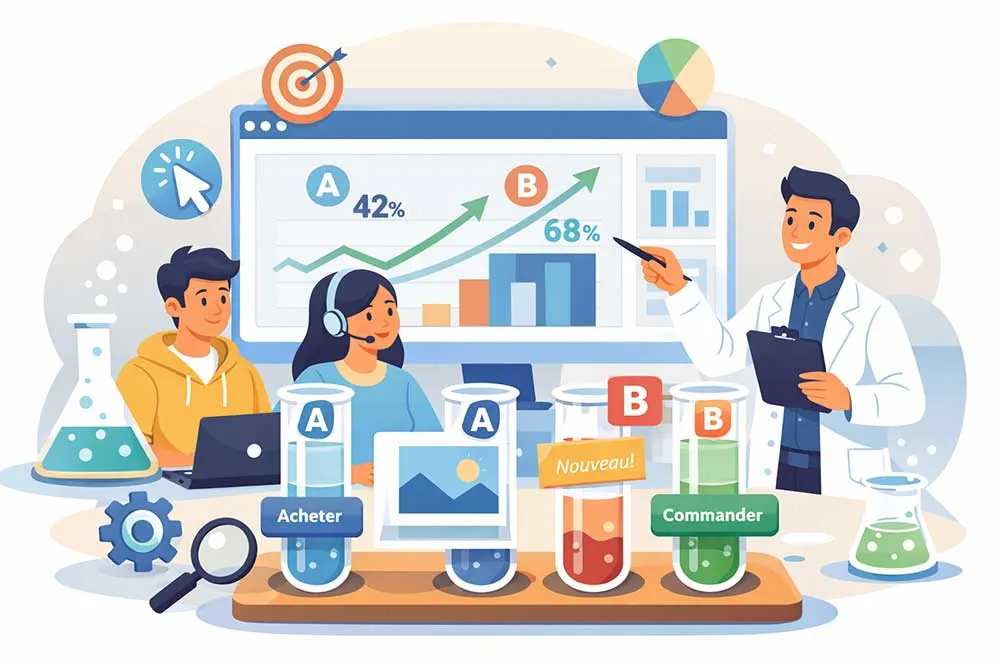
Optimisation is a matter of continuous testing and adjustment. A/B testing (or split testing) is an essential tool for fine-tuning your ads. The idea is simple: test different versions of your ads to see which works best.
You can test headlines, descriptions, calls to action, and even the look of the ads. For example, a catchier headline or a different image can sometimes make all the difference. Don’t settle for the “default” option: keep testing so your ads match what your audience is really looking for.
By experimenting constantly, you’ll find the winning combination that maximises your conversions while keeping a reasonable CPC.
Conversion optimisation example: testing headlines, images and more
Let’s take a concrete example: you have an ad for a beauty product, and you’re hesitating between two headlines. The first is simple: “Buy our day cream”. The second is more engaging: “Reveal your glow with our day cream”.
What to do? Run an A/B test! You test the two headlines side by side and see which generates the most clicks and conversions.
The same goes for images: a picture of your product on a white background, or a picture showing someone using it? Run the test and analyse the results. You might be surprised to find that small changes can have a huge impact on your performance.
Paid search trends to follow on Google: what’s going to change everything
Artificial intelligence and automation: the future of paid search campaigns
The artificial intelligence (AI) revolution is under way, and Google Ads is no exception. In 2025, AI and automation will redefine the way we manage paid search campaigns. Google Ads already uses smart tools to optimise your bids, adjust your ads based on user behaviour, and even predict future performance.
AI will allow finer and more efficient campaign management, reducing manual work while increasing performance. For example, thanks to machine learning, Google can now adjust bids in real time, based on the likelihood that a user will click on your ad or convert.
The future of paid search will therefore be strongly influenced by these technologies, and those who adopt them will have a head start.
How is AI changing the game for advertisers?
AI is turning Google Ads campaigns into a high-level game of strategy. It can now optimise your bids to maximise conversions, suggest adjustments to improve the relevance of your ads, and even identify market opportunities you hadn’t considered.
Artificial intelligence allows more responsive campaign management, which is essential in a world where trends change constantly. It helps you make decisions based on hard data and refine your campaigns without having to supervise everything manually.
Google Ads in 2025: new features not to be missed
Google Ads in 2025 is a bit like a treasure chest for advertisers. With responsive ads, for example, you can create several versions of your ads (headlines, descriptions, images), and Google will automatically choose the best combinations for each user.
What’s more, smart campaigns will become more and more popular. These AI-powered campaigns continuously optimise your bids, your ads and your targets to maximise performance without you having to step in constantly. In 2025, advertisers will need to be ready to adopt these new features, or risk being left behind.
In short, with AI and the new Google Ads features, 2025 is shaping up to be a pivotal year for paid search campaigns. It’s an exciting time, and those who stay at the cutting edge of technology will be the real winners.
Mistakes to avoid in Google Ads paid search: because we’ve all learned from our blunders
Poor budget management: how to avoid bankruptcy
Ah, budget management. It’s the elephant in the room of Google Ads paid search. All too often, you start with big ambitions and a comfortable budget, and after a few weeks you realise you’ve already emptied the piggy bank without really seeing results.
Feel like you’re caught in a whirlwind of pointless clicks? That’s normal, and it’s time to pause and re-evaluate your strategy. The most common mistake here is to set a budget without really understanding where the money goes.
You end up spending a lot on overly competitive keywords, with few conversions in return.
Tips for staying on budget without sacrificing performance
The key to avoiding ending up in the red? Track your spending closely and adjust your bids accordingly. Set a daily budget, but don’t let Google Ads do whatever it likes.
It’s essential to analyse keyword performance and redirect funds to those that deliver results. You can also prioritise bids for your most profitable keywords. If an ad works well, boost it.
If another one isn’t taking off, lower its bid or pause it. That way you’ll be smarter with your budget, without sacrificing the quality of your campaigns.
Ignoring the importance of mobile: users aren’t only on their PC
Today, who doesn’t have a smartphone within reach? And yet, many advertisers make the mistake of not adapting their ads to mobile. The result?
You miss out on millions of conversion opportunities. The reality is that users aren’t only on their PC. If your ad isn’t optimised for smartphones, you risk losing a significant part of your audience.
And we’re not even talking about the user experience, which can quickly become frustrating if the ad doesn’t display properly on mobile.
Adapting your ads to mobile is not optional!
Ads that display badly on mobile, or landing pages that are hard to navigate on a small screen, are a bit like selling a great car with flat tyres: it doesn’t make anyone want to buy. Make sure your ads are responsive (adapted to every screen size), and that your landing pages offer a smooth experience.
After all, mobile now accounts for a large share of web traffic, and it would be a shame not to take advantage of it.
Not tracking performance: what’s the point of running without looking where you’re going?
One of the most fatal mistakes is not tracking your campaign performance. Setting up a paid search campaign and not analysing it is a bit like sailing without a compass. You can have a huge budget, but without tracking the right KPIs (key performance indicators), you risk ending up in a rough sea without knowing where you’re headed.
Tracking KPIs to adjust in real time
KPI tracking is essential for adjusting your campaigns in real time. Focus on indicators like CTR, CPC, conversion rate and cost per acquisition (CPA). These figures tell you whether your ads are effective, where you’re overspending, or where you could improve the quality of your ads.
By constantly readjusting your campaigns, you maximise your chances of getting good results and of making every pound invested a profitable one.
How to succeed at paid search: the perfect advertiser’s guide
Best practices to adopt from the start
To succeed with your Google Ads campaign, there are a few basic best practices to adopt from day one. First, take care over how you write your ads. A good headline, a clear description and a punchy call to action are the bare minimum to capture your audience’s attention.
Next, define your budget properly, based on precise data rather than vague estimates. Finally, target the right audience: there’s no point wasting money reaching people who aren’t interested in what you offer.
A well-written ad, a well-defined budget, a well-targeted audience: the keys to success
These three elements are the pillars of any successful paid search campaign. A catchy ad is paramount to get users to click. If you want to avoid wasting money, targeting your audience correctly is just as important.
A badly defined budget is another trap to avoid. If you start with bids that are too high or a budget that is too low, you risk harming your results. The secret is to find a happy medium, adjusting everything based on observed performance.
The crucial role of landing pages: it’s not all about clicking the ad
Once a user clicks on your ad, the landing page has to live up to it. Attracting someone with an ad isn’t everything: the user experience on the landing page also has to be smooth. If your page loads slowly, is badly designed or isn’t convincing, your conversions are likely to drop.
So make sure your landing page is optimised for conversion, with clear elements such as call-to-action buttons, customer testimonials and a clean design.
Optimising landing pages for optimal conversion
Optimising your landing pages involves several points: loading speed, usability, and mobile adaptation. But there are also trust elements, such as customer reviews or guarantees. Every little detail counts when it comes to convincing the user to take action. Simplicity is often the key: the more intuitive the navigation, the more inclined users are to convert.
Retargeting: why returning visitors are worth their weight in gold
Retargeting, or remarketing, is one of the most powerful strategies in Google paid search. Basically, it consists of re-engaging users who have already interacted with your ads or visited your site, but haven’t converted. These visitors are already interested in your product or service, and following up with them can make all the difference.
It’s a bit like holding out a hand to them after they’ve wandered off a little. Retargeting offers an excellent ROI because it targets people who are already qualified and ready to take the step.
How to use retargeting to maximise conversions
The secret of retargeting lies in personalisation. Depending on the user’s behaviour (for example, if they visited a product page without buying), you can create specific ads to encourage them to come back. You can also adjust your bids for these specific users, bidding a little more on them, since they have already shown an interest in your offer.
Retargeting keeps the conversation open and lets you avoid abandoning any potential visitor.
Google Ads paid search: more than an investment, a real partner
Paid search is a long-term strategy for lasting results. It’s not a flash in the pan. Well managed, it’s a long-term investment.
It gives you immediate visibility, while constantly adjusting to maximise return on investment. Once you’ve mastered the best practices and avoided the common mistakes, Google Ads can become a reliable partner in the success of your marketing campaigns.
One last reminder before you go: what makes the difference on Google Ads is being strategic. Good budget management, a well-targeted audience, punchy ads and optimised landing pages: those are the keys to excelling. And don’t forget: always test, analyse continuously and adjust in real time.
So why not take action today? Now that you have all the cards in hand, what are you waiting for? It’s time to launch your Google Ads campaigns and watch your results take off. The hardest part is getting started; after that, the sky’s the limit. So, ready, steady, advertise!
And if it all feels too complicated to tame, a good PPC agency can help you out 😉
Also worth reading: the definition of SEA (paid search) and the 6 steps to launch a Google Ads campaign.