1. Home
  2. Web
  3. Hosting
Web · Hosting

Website hosting

Website hosting means storing your site’s code, content and database on a server that is permanently connected, so that your pages appear as soon as someone types your address into their browser. At Web Opteam, we host our clients’ sites on our own infrastructure, located in OVH data centres in France: business websites, online stores, WordPress or PrestaShop hosting, web applications, whether or not we built your site.

Our offer is a complete service, not just storage rented by the month and picked from a price comparison. Hosting your website includes regular backups, an SSL certificate, security patches, a configuration suited to your business and resources that scale with your needs. No admin panel to master and no tutorial to follow on your own: the team that runs the infrastructure is the one that knows your site. If you have a question or something goes down, you have a single point of contact, with no passing the buck between the host and the web team.

Let’s talk about hosting your site

What is website hosting?

A website is a set of files (source code, images, videos, documents) and, in most cases, a database holding the pages, posts, products or customer accounts. To be available at all times, all of this has to be installed on a server: a computer that runs around the clock in a data centre, connected to the internet over a high-speed link.

The principle is simple. Your domain name (such as web-opteam.com) points to the machine that hosts it. When someone opens a page, their browser contacts that machine, which runs the code (PHP for a CMS such as WordPress, PrestaShop or Joomla), reads the data and sends back the page to display. The web host provides the hardware, the bandwidth, the disk space and the software that keeps it all running.

So the domain and the hosting are two separate services: one is the address, the other is where your files live. They can be bought from different providers, and transferring one does not depend on the other.


Shared, VPS, dedicated or cloud: the types of hosting

Not all hosting is equal. The type of plan determines the resources actually available to you (processor, memory, storage), the level of security and how much of the administration falls to you.

Shared hosting

Hundreds of sites may share the same machine. It is the entry-level plan of consumer web hosts, managed from a panel such as cPanel, and suits a small site or a blog. Its limits: a resource-hungry neighbour slows your pages down, and a hacked neighbour can open the door to attacks.

Virtual private server (VPS)

One physical machine is split into virtual machines, each with its own reserved share of processor and memory. You gain control and consistency, but system administration (updates, security, backups) is up to you unless the plan is managed.

Dedicated server

A whole server is reserved for one project or a group of projects. Performance and control are at their highest, for a higher cost and greater technical demands. It is the top tier, chosen by high-traffic ecommerce stores and business applications.

Cloud hosting

Resources are spread across several machines and adjust to the load, with high availability as the goal. That flexibility suits projects whose traffic varies a lot, often with usage-based billing and a more technical setup.

For our clients, we use dedicated or semi-dedicated servers (a machine shared by just a few sites), which we administer ourselves. You get the benefit without having to manage the machine: your site is not lost among hundreds of others, and its configuration is designed for it.

What our hosting service includes

Our hosting includes what matters day to day for a professional website, with no premium pack or extra options to add along the way.

Servers in France

Our infrastructure is located in OVH’s French data centres. Your data and your users’ data stay in France, within the EU.

Regular backups

Your files and database are backed up regularly, so everything can be restored after an outage, a mistake or a hack.

Server security

We apply system security patches and install the SSL certificate, so your pages are served over HTTPS.

An optimised configuration

Our servers run PHP 8, MySQL/MariaDB, phpMyAdmin, Node.js, Git and Composer: everything needed to run a CMS or a web application built for you.

Storage that scales

Blog, product catalogue, client documents: storage is sized for your project, and we adjust resources as it grows.

Support that knows your site

No call centre: your questions are handled by the team that built or looks after your site, and your logins are stored in your Hub Opteam client portal.

WordPress, PrestaShop and custom site hosting

Every type of site has its own requirements, and effective hosting starts with a configuration that matches the site’s technology and features.

  • WordPress hosting: the PHP version recommended for the core and plugins, caching, an optimised database. The goal: keeping a WordPress business website or blog fast as the number of pages and posts grows. See our business website design page.
  • PrestaShop or WooCommerce store: a product catalogue, lots of images, a checkout, traffic peaks during the sales, sometimes multi-store management as for Kaviari. An ecommerce site needs a stable platform so it does not lose sales. See our ecommerce website page.
  • Web application: Composer, Git and Node.js are available on our servers to deploy Symfony projects cleanly, like this site. See our custom web development page.

Not every technology works with every kind of hosting. When a PHP version or a tool becomes obsolete, we let you know before it starts to hold your website back.

Why hosting matters for speed and SEO

Hosting speed is the starting point for loading every page. A slow or overloaded machine delays everything else, whatever optimisations come afterwards. Google’s documentation for web developers confirms it: a high server response time delays the Largest Contentful Paint by the same amount, and LCP is one of the three Core Web Vitals (web.dev, “Optimize Time to First Byte”).

Google states that Core Web Vitals are used by its ranking systems, while pointing out that search still shows the most relevant content even if the page experience is average (Google Search Central, “Understanding page experience in Google Search results”). Good hosting will not push your pages up the search results on its own, but slow hosting can hold back a well-built site and drive visitors away before the page even appears.

To go further, our experts carry out a technical SEO audit that checks, among other things, the speed and quality of your hosting.

How to choose hosting for your website

There is no such thing as the best host in absolute terms: a comparison of plans is only worth something against your needs, and online reviews often reflect uses very different from yours. What matters is comparing plans criterion by criterion:

  • Type and capacity: shared, VPS or dedicated, memory, SSD or NVMe storage, traffic limits. Compare what is actually made available to you, not just the plan name: two plans at the same price can hide SATA SSDs on one side and NVMe on the other.
  • Location: hosting in France makes it simpler to handle your customers’ personal data under the GDPR and your privacy policy.
  • Backups: automatic or not, included or extra, how often, how long they are kept, where they are stored and who handles restoring them. A copy kept on the site’s own machine does not protect you against a disaster (fire, hardware failure) hitting that server. Every copy should also be test-restored.
  • Security: system patches, anti-DDoS protection, SSL certificate included or free. When it comes to security, ask exactly what remains your responsibility.
  • Availability: the advertised uptime and, above all, what the contract provides if something goes down. High uptime on paper says nothing about how quickly anyone responds when the site is down.
  • Technical support: tickets, phone, a person who actually answers or a link to a guide? An agent who does not know your site will often send you back to your developer.
  • Renewal price: many plans show a discount when you sign up; look at the price from renewal, set-up fees and the length of commitment.
  • Ownership and reversibility: the domain, the hosting and the logins should be in your name, so you can change provider without being locked in.

Consumer web host or managed hosting: which to choose?

Consumer web hosts offer plans you can sign up for in a few clicks and pick up easily: a monthly plan, often cheaper in the first year than at renewal, a user-friendly interface (cPanel, for example), one-click WordPress installs and tutorials to help you get by. For a personal site or a trial project, that is enough. Online website builders go further: hosting is built into the subscription, but a site made with a website builder stays tied to its platform and its features, and is hard to move elsewhere. That kind of tool works for testing an idea, less so for a project that needs to grow.

With a consumer web host, on the other hand, everything that happens after launch is up to you: updates, monitoring, restoring after a hack, tuning when the site slows down. Managed hosting hands that part over to professionals: that is what our agency offers. It makes sense when your website directly supports your business (quotes, sales, bookings) and nobody in-house has the time or the know-how to look after it.

How much does website hosting cost?

The price of hosting depends on the type of server, the power required, the expected traffic and the services included (backups, security, support, interventions). A small business website and an online store with a large catalogue do not have the same needs, or the same cost.

Be wary of comparisons based on the advertised price: a plan that is cheap to start with sometimes costs a lot more at renewal, and you need to add the paid options (backups, certificate, email address), which soon push the bill up. Compare what hosting costs over several years, for equivalent services: that is the only value for money that counts.

At Web Opteam, hosting is a line in your quote, which is free and with no obligation, detailing what it includes. You know from the outset what you are paying for and what you get.

Switching hosts without downtime

Is your site already hosted elsewhere and would you like to hand it to a responsive team? We move it to our hosting in four steps:

  1. Collecting the logins

    Current hosting, FTP, database, domain: we gather the information with you, including when the previous provider is slow to hand it over.

  2. Copying and testing

    Every file on the site and the database are copied to our infrastructure, then the site is tested before anything is switched over.

  3. Switching the domain

    The domain’s DNS records are changed to point to the new hosting, checking redirects and the SSL certificate along the way, to avoid any downtime.

  4. Final checks

    Forms, emails sent by the site, payment, speed: we check that everything works after the migration.

That is what we did for the Little Victoire micro-nursery: recovering the access held by the previous provider, migrating to a dedicated server, then maintaining both the server and the WordPress site. Today, the company owns everything that concerns it. For Kaviari, we helped choose responsible hosting in line with the brand’s commitments, and we manage that hosting.

Preview of the Little Victoire website

Little Victoire

Little Victoire is a bilingual, eco-friendly micro-nursery. Mina (the founder) was working with an agency…

Preview of the Kaviari website

Kaviari

Kaviari is a family-run caviar house whose expertise and quality have endured since 1975. Since the days of…

Preview of the Adhoc Consult website

Adhoc Consult

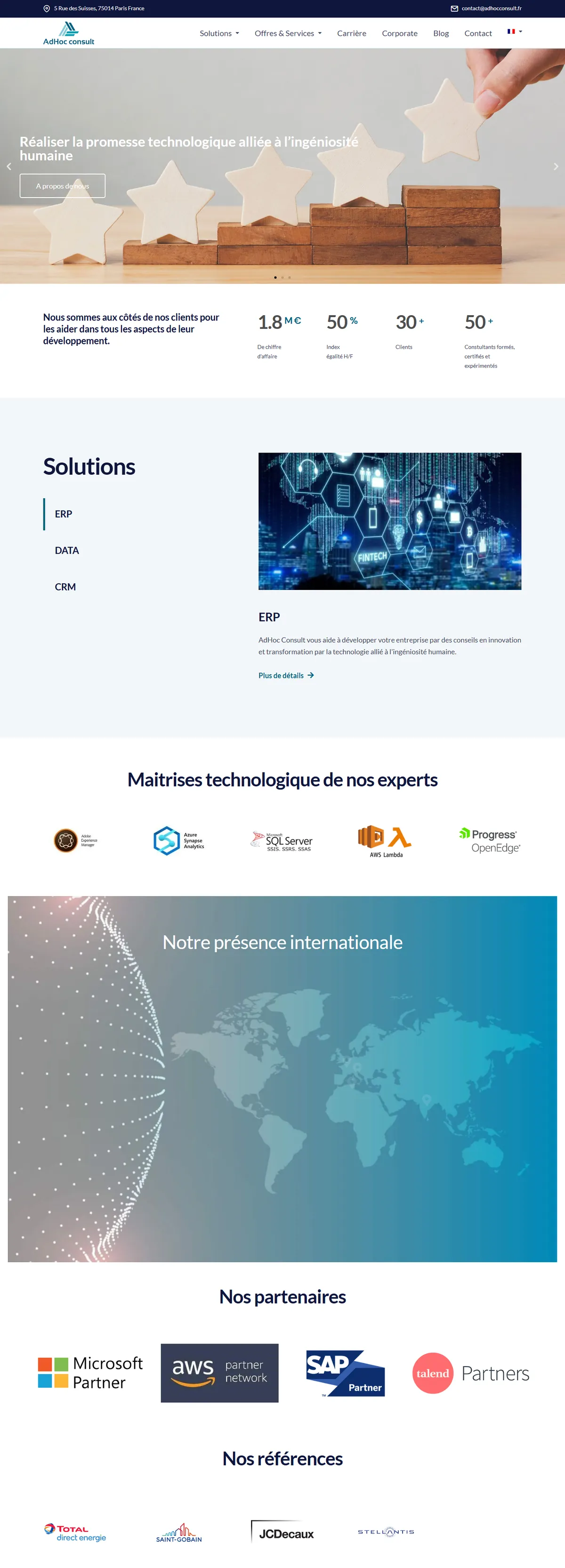
AdHoc Consult is an international consulting firm specialising in innovation and technological…

See all our case studies

Hosting and maintenance: two services that go together

Hosting takes care of the machine: keeping it available, secure, backed up and powerful enough. Maintaining your website takes care of the site itself: updating WordPress or PrestaShop, plugins and modules, fixes and small improvements.

The two go hand in hand: when a single team handles both hosting and maintenance, nobody passes the buck when something goes wrong. Would you rather stay with your current host? We can still maintain your site where it is.

Hosting as part of complete digital support

Web team

Building a new site, redesigning it or developing it for your specific needs: we design your website and host it on a server configured for it, with a single point of contact from start to finish.
Find out more

SEO team

Fast hosting is a starting point. Organic search also needs a sound structure, useful content and ranking tracking.
Find out more

Web Analytics team

Measuring traffic, conversions and user behaviour tells you whether your site is meeting its goals and bringing in new customers.
Find out more

Looking for reliable hosting for your website, or want to leave your current host? Get in touch: we will look at your situation by video call and recommend the right solution, whether you are in France or abroad.

Contact us

Website hosting FAQ

What is the difference between a domain name and hosting?

The domain is your site’s address (example.com); hosting is the space where its files and data are installed. They are rented separately, the domain often by the year, and can be managed by two different providers.

Can a business website be hosted for free?

There are free hosting plans, but they usually come with ads, a subdomain address, little power and no service guarantee. For a site that represents your business, paid hosting remains the sensible choice.

Where are your servers?

Our servers are located in data centres in France, so your website’s data and your customers’ data are hosted there.

Can you host a site you did not build?

Yes. The Little Victoire site, for example, was built by another provider: after recovering the access from the previous provider, we migrated it to a dedicated server and we maintain it.

Who owns the site and its data?

You do. The site, its content and its data belong to you, and your technical logins (hosting, admin area, tools) can be viewed at any time in your Hub Opteam client portal.

What if your next website became your best salesperson?

Keep in touch!

We reply within one business day, in English, with an honest first opinion, even if it shakes things up a little.

By submitting this form, I agree that the information entered will be used to handle my enquiry and any business relationship that may follow. Privacy policy.