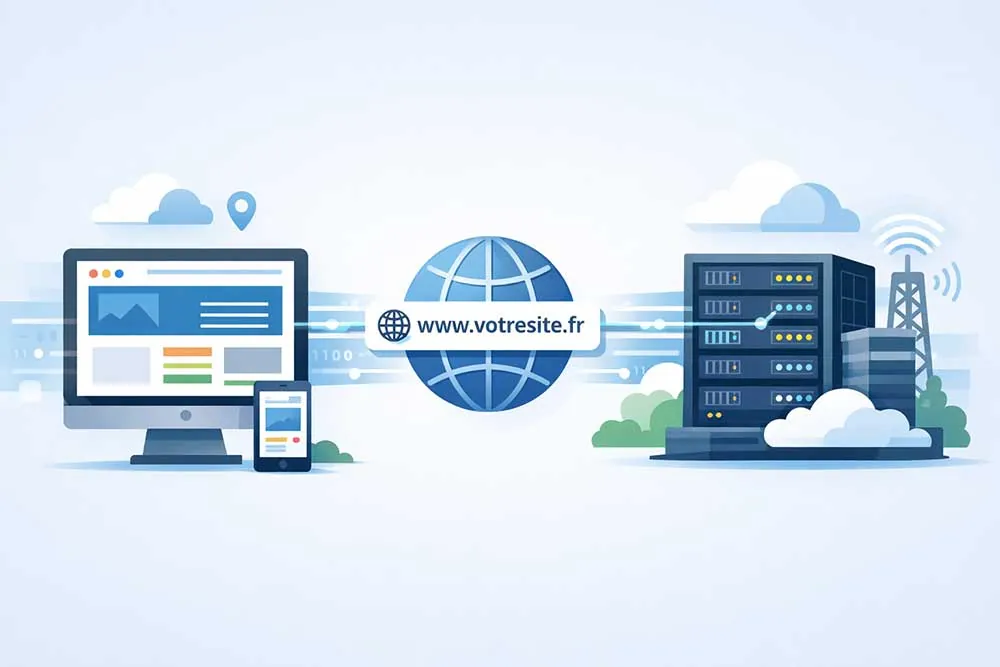
On the internet, your domain name is your address. Your unique identifier on the web. The first thing your customers type into their browser to find you.
Without an address, nobody can locate you. With a bad address, everyone gets lost. And with an address that isn’t properly protected… someone else can register it in your place and claim a name identical to yours on an extension you hadn’t thought to reserve. Believe us, it happens.
Whether you want to look at the options available for your registration, fine-tune your choice of name before you create a website, or simply find the right resource to talk about your product from the top of the page, this guide is for you.
Indeed, whether you are a business looking for a reliable registrar for your second-level domain, a professional who wants to register a name that will make up your future brand identity, or an individual who simply wants to build a site, registering your domain name is a key step.
It shapes your title on the web, the structure of your online presence, and even the quality of your customer service by email through an address in your own name.
In this complete guide, we cover everything: from how a name is allocated to domain registration, through choosing a hosting provider, the help resources available, the plans offered by registrars, and good practice for contact and support.
By the end you will have all the keys to make the right choices, including how to avoid the mistakes that even Wikipedia wouldn’t tell you about.
What exactly is a domain name?
Definition: a domain name, the identifier of a website on the internet
A domain name is a unique web address that identifies a website on the internet in a simple way that internet users can understand. It’s what you type into your browser’s address bar to reach a website: “webopteam.fr”, “wikipedia.org” or “lemonde.fr” are examples of domain names.
The official definition, as worded by AFNIC (Association Française pour le Nommage Internet en Coopération, the French domain registry that manages the French extensions), is this: a domain name is a website identifier that forms a memorable, easy-to-remember internet address, allocated uniquely to its holder.
In other words, two websites can’t have the same domain name: a domain is unique, just like a postal address in the physical world.
The Domain Name System: how it works behind the scenes
Behind every domain name lies a technical reality that most users never need to know about, but which is worth a minute of your time to understand how important this system is. On the internet, every server is identified by an IP address: a string of numbers such as “192.168.1.1” (for IPv4) or an even more complex string for IPv6.
These addresses are perfectly readable for a computer, but not memorable at all for a human being.
The Domain Name System (DNS) is the system that links an understandable domain name, such as “webopteam.fr”, to the IP address of the server where the site is hosted. When you type a domain name into your browser, DNS translates that name into an IP address within milliseconds, and your browser can then reach the right server to display the web page.
This is called DNS resolution, and it’s what makes the internet accessible to everyone, even those who couldn’t remember a twenty-character IP address.
The structure of a domain name: SLD, TLD and levels
A domain name is made up of several parts separated by dots. Take a concrete example: “webopteam.fr”. This address breaks down into two main elements.
The first is the SLD, Second Level Domain. It’s the central part of the name, the one you choose freely: “webopteam” in our example. It forms the core of your online identity and needs to be memorable, relevant and available.
The second is the TLD, Top Level Domain. It’s the extension that comes after the dot: “.fr”, “.com”, “.org”, “.net”… The TLD indicates the nature or geographic origin of the site. A “.fr” points to a French-focused site, an “.org” traditionally designates an organisation, and “.com” is the best-known and most widely used commercial extension in the world.
Some domain names have a third level: that’s the case for subdomains, such as “blog.webopteam.fr” or “shop.example.com”. A subdomain is an extension of the main domain that lets you split a website into several distinct spaces, each reachable through a specific address.
Types of domains and their extensions
Generic extensions: .com, .net, .org and the rest
Generic top-level domains, known as gTLDs, are the best-known extensions on the internet. .com is without doubt the most famous and most used: originally reserved for commercial businesses, it’s now open to everyone and remains the worldwide reference for any type of website.
.net was originally intended for networks and internet providers. .org is traditionally associated with non-profit organisations, associations and institutions.
These generic extensions have the advantage of being universally recognised and memorable. Their downside? .com domain names are often already taken, so you have to be creative to find an available name. A useful resource for exploring availability is the Domainr tool, which quickly shows you the combinations available across different extensions.
National extensions: .fr, .de, .es and the ccTLD family
National extensions, known as ccTLDs (Country Code Top Level Domains), are tied to a specific country or territory. .fr is the French extension, managed by AFNIC. It’s the reference for any business, association or professional who wants to assert their roots in France and target a local or national audience. In the same way, .co.uk or .uk serve the United Kingdom and .de serves Germany.
For a French business that mainly addresses a French target audience, .fr has several advantages. It strengthens the trust of French users, who see this extension as a sign of seriousness and proximity. It’s also slightly favoured by search engines for location-based queries in France.
And it tells your customer clearly, as soon as they read your address, that you are a player rooted in the French ecosystem.
New extensions: .paris, .shop, .blog and new-generation gTLDs
Since 2013, ICANN, the international body that oversees the allocation of domain names on the internet, has opened the door to hundreds of new extensions. Today there are geographic extensions such as .paris or .bzh, sector-based extensions such as .shop, .agency, .tech or .blog, and even brand extensions used by large companies.
These new extensions offer interesting opportunities for businesses and professionals looking for an original, memorable domain name directly linked to their activity or territory. A Paris-based web agency might, for example, choose .paris to strengthen its local roots, while a food blog could use .blog to make the nature of its main content clear straight away.
.fr vs .com: which should you choose for your project?
The choice between .fr and .com is one of the questions asked most often when creating a website. The answer depends largely on your target and your ambitions.
If your business is mainly French, you target a local or national audience, and your brand isn’t meant to go international in the short term, .fr is the most natural and relevant choice. If, on the other hand, you have international ambitions, you address an English-speaking audience or you want to position yourself on a global market, .com remains the essential reference.
The most common and most recommended practice for a mid-sized French business is to register both: .fr for the French market and .com to protect its brand internationally. It’s a modest investment that avoids a lot of problems, notably disputes caused by a third party taking your domain name on an extension you haven’t reserved.
How do you choose your domain name?
The golden rules of a good domain name
A good domain name is first and foremost one that is easy to remember, simple to type and directly tied to your brand or your activity. These criteria may seem obvious, but they are often sacrificed to poorly managed creativity, or to poor-quality pragmatism that ends up with domain names impossible to remember.
Here are the main rules to follow to make the right choice. First, prefer a short name: the fewer the characters, the easier it is to type and remember. An ideal domain name is between 6 and 15 characters.
Then pick a simple, phonetically clear name: your domain name should be understandable when spoken aloud, which matters especially for word of mouth and voice search.
Avoid numbers in your domain name unless they are an integral part of your brand. A number in a domain name creates ambiguity (should the number be spelled out or written as a digit?) and makes it harder to remember. Likewise, avoid hyphens: they cause confusion, are hard to dictate and are often associated with lower-quality sites in internet users’ eyes.
Linking it to your brand, your activity and your project
Your domain name should reflect your online identity. For a business, the natural choice is to use the company or brand name: it’s the most direct way to create a clear link between your name and your web address. For an independent professional, first name and surname often make a good base, simple and memorable.
If your brand name is already taken on the extension you want, several solutions are open to you. You can add a keyword linked to your activity or your city: “plombierlyon.fr” or “fleuristenantes.fr”, for example. You can choose a different extension.
Or you can slightly rethink your brand name so it is both unique and available. Either way, take the time to think it through: your domain name is a long-term asset, and a bad initial choice is hard and costly to fix.
Checking name availability: tools and methods
Before falling in love with a domain name, check that it’s available. Several tools make it easy and free. WHOIS is the reference service for looking up a domain name’s registration information and checking whether it’s already allocated or available.
AFNIC provides its own availability checker for French extensions. Registrars such as OVHcloud, GoDaddy or Namecheap also offer built-in availability search tools, often very handy because they automatically suggest alternatives on other extensions.
The Domainr tool is particularly useful for quickly exploring a large number of extensions at once and spotting the available combinations. In a few seconds it shows you all the options so you can make an informed decision on the best domain name.
Thinking about trademark protection and intellectual property
Choosing a domain name isn’t just about finding an address available on a registrar. You also need to make sure the name doesn’t infringe a third party’s rights, and conversely that your own brand is properly protected.
In France, trademark protection is the responsibility of the INPI (Institut National de la Propriété Industrielle, the French intellectual property office). Before registering a domain name, it’s strongly advised to check that the name isn’t identical or similar to a trademark already registered in your sector.
A domain name dispute can have serious consequences: an order to stop using the name, forced transfer of the domain, or even legal action for copyright or trademark infringement.
Conversely, if you register a domain name matching your brand, consider registering that trademark with the INPI to strengthen your protection. The first-come, first-served rule that governs domain name allocation can work against you if an ill-intentioned competitor reserves your name on an extension you haven’t registered yet.
Anticipating disputes and aligning your domain name with your social networks
A well-chosen domain name is also one that is available, or can easily be adapted, on the main social networks. Before confirming your choice, check that the same name (or a close variant) is available on the platforms you plan to use: LinkedIn, Instagram, X (formerly Twitter), Facebook…
This consistency between your domain name and your social media handles makes your brand easier to recognise, strengthens your online identity and makes your communication smoother for customers and partners. It may seem like a minor detail, but it makes a real difference to how professional you look on the internet.
How do you register and reserve a domain name?
What is a registrar?
A registrar is a provider accredited by ICANN (or by national authorities such as AFNIC for .fr) to register domain names. It’s with a registrar that you register your domain name, manage its renewal and configure its DNS settings.
There are hundreds of registrars around the world. In France, the best known are OVH and OVHcloud, which are among the leaders of the European market. Internationally, GoDaddy and Namecheap are widely used references, particularly for generic extensions such as .com.
The choice of registrar depends on several criteria: prices, quality of customer support, the management tools provided and the extra services offered (web hosting, website builder, email address, etc.).
The role of ICANN and AFNIC
ICANN, the Internet Corporation for Assigned Names and Numbers, is the international organisation responsible for coordinating the internet naming system worldwide. It accredits registrars, sets the rules for allocating domain names and oversees the creation of new extensions.
For French .fr extensions, AFNIC plays this role at national level. As the French association for cooperative internet naming, it manages the .fr domain name registry and sets the eligibility conditions for registration requests.
Any individual or legal entity with an address in France (business, association, private person) can register a .fr domain name.
Registration procedure: the key steps
Registering a domain name is now a simple, quick process that can be done online in a few minutes. Here are the main steps to follow.
Step one: choose your domain name and check its availability using the search tool of the registrar of your choice or via WHOIS. If the name is available, move on to the next step. If it isn’t, explore alternatives: another extension, a variant of the name, an added keyword.
Step two: choose your registrar and create a customer account. You will need to provide your full contact details: surname, first name, postal address, email address and phone number. This information is mandatory because it identifies you as the domain name holder.
Step three: book and pay. The cost of a domain name varies with the extension chosen: a .fr or a .com can generally be reserved for less than 15 euros a year. Some rare or highly sought-after extensions can be more expensive. Beware of offers that give you a “free” domain name: often it’s only the first year that is free as part of a web hosting subscription, with paid renewal in the following years.
Step four: configure your domain name’s DNS settings to point it at your hosting server. This step is needed to make your website reachable through your domain name. Most registrars offer an intuitive management interface for this configuration.
Buying a domain name that is already taken: the secondary market
If the domain name you want is already registered by someone else, all is not lost. There is a secondary market for domain names, where thousands of web addresses are put up for sale by their holders. Platforms such as Sedo or Flippa let individuals and professionals buy and sell domain names.
Prices on this secondary market can range from a few tens of euros to several million for highly coveted names. Before buying a second-hand domain name, check its history: a name that has been used for dubious activities or spam may have a bad reputation with search engines, which would hurt your SEO from the start.
Domain name and web hosting: don’t mix them up
Two distinct things, often sold together
One of the most frequent confusions among people building a website for the first time is mixing up the domain name and web hosting. They are two quite separate things, even if providers often offer them together.
The domain name is your address on the internet: it’s what people type to reach your site. Web hosting is the space on a server where the files that make up your website are stored: pages, images, videos, database, main content, etc. Without hosting, your domain name points to nothing. Without a domain name, your site is hosted but impossible to find.
Registrars such as OVHcloud generally offer both services in bundled packages, which simplifies management for beginners. But it’s perfectly possible, and sometimes advisable for technical or pricing reasons, to use different providers for your domain name and your web hosting.
Domain name and professional email
One of the often underestimated benefits of having your own domain name is the ability to create a professional email address from it. Rather than using a generic address like “mycompany@gmail.com”, you can use “contact@webopteam.fr” or “info@yourbrand.com”.
This professional email address greatly strengthens your business’s credibility in the eyes of customers and partners. It shows that you have invested in your online identity and take your business seriously. Most registrars and hosting providers offer this service as part of their hosting plans, often at a very modest cost.
The role of the domain name in SEO
The domain name plays a role in your organic search strategy, although that role is more nuanced than is often believed. A well-chosen domain name can make your address easier for internet users to remember, strengthen the consistency of your brand identity and contribute positively to your online visibility.
The extension you choose also matters: a .fr favours rankings for location-based queries in France in search engines. An old, well-established domain name generally has better authority in Google’s eyes than a freshly registered one.
And a domain with a good reputation, meaning one that has never been used for spam or black hat SEO, starts with an undeniable advantage.
Protecting and managing your domain name over time
The rights of a domain name holder
As a domain name holder, you have an exclusive right to use that name for the duration of your registration. This right is personal and not transferable without your agreement. You can use your domain name to build a website, set up an email address, sell it to a third party or transfer it to another registrar.
In return, you have obligations: keep your holder details up to date with your registrar, renew your registration before it expires and make sure your use of the domain name doesn’t infringe third-party rights. Failure to meet these obligations can lead to your domain name being suspended or deleted.
Legal issues: copyright, trademark protection and disputes
Domain name disputes are unfortunately common on the internet. The most frequent cases involve cybersquatting: the practice of registering a domain name matching a well-known brand in order to resell it at a high price or to harm its legitimate owner.
To protect yourself against this kind of dispute, the best defence is prevention: register your domain name on the main extensions as soon as possible, register your trademark with the INPI if you haven’t yet, and regularly monitor new registrations of domain names close to yours.
Monitoring tools can alert you automatically when a name similar to yours is registered.
In case of a proven dispute, several allocation procedures exist to recover a domain name registered in bad faith. For generic extensions, ICANN has set up the UDRP (Uniform Domain-Name Dispute-Resolution Policy). For .fr, AFNIC handles the dispute resolution procedures.
Don’t let your domain name expire
Domain name expiry is one of the most concrete and most avoidable risks for a business or professional. If you forget to renew your registration before the expiry date, your domain name can be released and registered by someone else, including speculators who will then sell it back to you at a premium.
The solution is simple: set up automatic renewal with your registrar and make sure your contact details and payment information are always up to date. Some registrars also offer grace periods after expiry, during which you can still renew your domain name. But it’s better not to count on that: prevention remains the best approach.
Managing several domain names: good practice
If you manage several domain names, for different brands, different projects or different extensions of the same name, a few good practices apply. Centralise the management of your domains with a single registrar where possible: it simplifies tracking renewal dates and managing DNS settings.
Use a dashboard or management tool to get an overview of all your domains, their expiry dates and their configurations.
Define clearly the role of each domain name: is it the main domain of your website? A redirect domain to protect your brand? A domain dedicated to a specific project or marketing campaign? This clarity in how you organise things will save you configuration errors and costly renewal oversights.
Web Opteam: your Paris-based agency for building your online presence
The importance of the domain name in an overall digital strategy
The domain name is much more than a simple technical address on the internet. It’s the first building block of your online identity, the starting point of your digital strategy, the reference you give your customers, partners and prospects so they can find you on the web. A good domain name lays the foundations for a solid, consistent and lasting online presence.
But the domain name alone isn’t enough. It’s part of a broader ecosystem that includes website creation, SEO, content strategy, social media presence and many other levers. That’s where a digital agency like Web Opteam comes in.
Web Opteam supports you from A to Z
At Web Opteam, a digital agency based in Paris, France, working remotely with clients worldwide, we support businesses, associations and professionals in building their online presence, from website creation to SEO optimisation, through paid search (PPC) and data analysis.
Our team of digital professionals is at your disposal to advise you on choosing your domain name, guide you through the registration procedure and help you build a consistent, high-performing digital strategy.
Whether you are an SME, a fast-growing start-up or an organisation looking to develop its online presence, we have the skills and tools to support you at every stage of your project. Feel free to contact us for personalised advice and tailor-made support.
Your domain name is your address on the internet. You might as well choose it well.
The domain name is often the last thing people think about when they create a website, and yet it’s one of the first decisions to make. It’s your online identity, your unique web address, the name by which you will be known and found on the internet for years.
Choosing it well gives you every chance of building a strong, memorable online presence. Registering it well protects your business and avoids costly disputes. Managing it well over time makes sure your space on the internet stays yours, and only yours.
You now have all the information you need to make the right choices. And if you need help, advice or support to create your website and grow your online presence, the Web Opteam team is here. Get in touch: we love talking about domain names as much as we love SEO, and that’s saying something.