46% of Google searches have a local intent. When someone types “restaurant Paris”, “plumber Lyon”, “SEO agency near me” or “hairdresser open now” on their mobile phone, Google shows the best-optimised local businesses first, in what is called the local pack: the block of three geolocated results at the top of the first page, even before the classic organic results.
Being found locally is the central challenge of any local marketing strategy. And optimising your Google listing, building a well-structured website and looking after your Google page are the three basic pillars for getting there and catching visitors’ interest.
If your company, shop or store doesn’t show up there, your competitor across the street gets the customer, thanks to a better-positioned brand, a more active social profile and a stronger recommendation in local results. Without any effort on their part, without you even knowing, and often for the long term.
Every day without local visibility, traffic, phone calls and customers go elsewhere. The good news: depending on the actions you take today (updating outdated information, connecting your tools, increasing your number of reviews), results can be visible within a few weeks.
Local SEO is used successfully by thousands of French SMEs, and it can help you turn things around, provided you give it a minimum of time and method.
Local SEO, also called local search engine optimisation, is the strategy that lets businesses of all sizes improve their visibility in local search results and attract new customers in their geographic area. It is one of the most effective and cost-efficient levers in digital marketing for SMEs, craftspeople, restaurants, local shops and any business whose activity relies on a local clientele.
In France, whether you are based in Paris, in a large regional city or in a medium-sized town, local SEO gives you a real chance to take advantage of your geographic roots and strengthen your online presence.
In this complete guide we explain everything: the definition of local SEO, how to create and optimise your Google Business Profile, local content strategy, customer review management, citations and local directories, and best practices for dominating local search results in your industry.
Step by step, with concrete examples for real-world businesses: craftspeople, restaurants, agencies, shops and SMEs.
Local SEO: definition and what’s at stake
What is local SEO?
Local SEO, also called local search optimisation, is the set of techniques and strategies aimed at improving a business’s visibility in geolocated search results.
Unlike classic organic search, which aims to rank a website for general queries, local SEO focuses on local queries: those that include a place (city, region, neighbourhood) or an intent of proximity (“near me”, “open now”, “in my town”).
The definition of local SEO can be summed up like this: it is the geographic optimisation work that makes your business show up in a good position on Google Maps, in the Google local pack and in local search results when someone searches for something related to your activity in your area.
In practical terms, it is what makes a shop, a healthcare centre or a local organisation appear on the Google map ahead of its competitors. The importance of this positioning for a local SME is huge: it is often the difference between being consulted first and being ignored.
Local SEO is essential for any business whose customers are geographically targeted: restaurant, craftsperson, medical practice, estate agency, retail shop, hairdresser, garage, school, charity: the list is long. In France, where the economy is mostly made up of local SMEs and very small businesses, local SEO offers a considerable business-development opportunity at low cost, with no need for a premium domain name or an expensive software licence.
The difference between classic SEO and local SEO
Classic organic search aims to rank a website for general queries in Google’s organic results, with no particular geographic consideration. An ecommerce site selling shoes across the whole country, a blog about digital marketing, a SaaS tool available to everyone: these are classic SEO.
Local SEO adds a geographic dimension: the goal is to appear for queries tied to a precise area. The ranking factors are different: on top of the usual SEO criteria (content quality, domain authority, technical SEO), Google takes into account the geographic proximity of the business to the user, the completeness and quality of the Google Business Profile listing, and local reputation (customer reviews, mentions in local sources).
It is this combination of factors that makes local SEO so specific, and that calls for a dedicated strategy, different from classic web SEO.
The Google local pack: goal number one
The local pack, sometimes called the “3-pack”, is the block of three geolocated results that Google displays at the top of the results page for queries with a local intent. It shows three businesses with their name, address, phone number, opening hours, rating and number of reviews, plus direct access to Google Maps.
Appearing in this local pack is goal number one of local SEO: studies show that the three businesses shown in the local pack capture the vast majority of clicks on local queries, far more than the classic organic results displayed below.
For a restaurant, a craftsperson or a local shop, being in this pack can radically change foot traffic and the number of new customers.
The rise of mobile and voice search
Local search is closely tied to mobile use. Most local searches are made from a mobile phone, often on the move, often with an immediate purchase intent. A mobile user searching for “pizzeria open now near me” is a potential customer who will make a decision within the next few minutes.
If your business doesn’t appear in the top results, you miss that opportunity.
Voice search amplifies this trend: voice queries are even more local and conversational than text searches. “Hey Google, find me a plumber in Paris 11th” or “Alexa, what’s the best-rated restaurant near me?”: these voice queries are handled by the same algorithms as classic local searches, but with an even higher demand for the quality and completeness of the business’s information.
Google Business Profile: the absolute foundation of local SEO
What is Google Business Profile?
Google Business Profile, formerly known as Google My Business, is the free tool provided by Google so that businesses can manage their presence on Google Search and Google Maps. It is the listing that appears in the local pack, in local search results and on Google Maps when someone searches for your business or for an activity in your area.
Creating a Google Business Profile listing and optimising it is the first, and most important, step of any local SEO strategy. Without a complete, optimised Google Business Profile, your business has very little chance of appearing in the local pack, however good your website or your social media presence may be.
Creating and optimising your Google Business Profile
To create a Google Business Profile listing, go to business.google.com, sign in with your Google account and follow the registration steps. You will need to verify your business, usually with a code sent by post to your company’s address, or through other verification methods available depending on your type of activity.
Once your listing is created, optimisation is a crucial step to improve your local visibility. Here are the essential items to fill in carefully:
The business name must match your company’s official name exactly, without adding artificial keywords, which Google penalises. The address must be precise and consistent with the information on your website and in your directories. The phone number must be a local number (not a premium-rate one), easy to reach and consistent across all your channels.
Opening hours must be up to date and changed for public holidays, holidays or any temporary change of hours. The primary category must accurately reflect your main activity; it is one of the most important ranking criteria in local SEO. Secondary categories let you add complementary activities.
Photos: an often overlooked lever
Photos play an important role in the appeal and ranking of your Google Business Profile listing. Businesses that regularly post photos receive, on average, more direction requests and clicks to their website than those that don’t.
Add quality photos of your business (front of house, interior, products, team), updated regularly. For a restaurant, photos of the dishes are particularly important. For a craftsperson, before/after photos of completed work are very effective. For an agency or a practice, photos of the team and the premises humanise your online presence and build trust.
Google Business Profile posts
The “Posts” section of Google Business Profile lets you share news, offers, events or updates directly on your Google listing. These posts appear in your listing during searches and help keep your profile active, a positive signal for Google’s algorithm.
Post regularly, ideally once a week, relevant content for your local customers: a new offer, a local event, seasonal advice, news from your industry. Using the posting feature regularly is a simple but effective lever to improve your local visibility.
Optimising your website for local SEO
Geolocated keywords: targeting the right queries
On-page optimisation of your website for local SEO starts with identifying the relevant geolocated keywords for your activity. These queries combine your industry and your geographic area: “plumber Paris 15”, “vegetarian restaurant Lyon”, “web agency Bordeaux”, “men’s hairdresser Toulouse”.
These keywords should be worked naturally into the key elements of your web pages: page title, meta description tag, H1 and H2 headings, page text, image alt attributes and URL.
Your website’s home page should clearly state your activity, your location and your service area, for search engines as much as for your visitors.
For businesses present in several cities or regions, create one dedicated page per location: a “Plumber Paris” page, a “Plumber Versailles” page, a “Plumber Vincennes” page, each optimised with content specific to that area. This approach multiplies your chances of appearing in local results.
Local content: create to attract
Local content is one of the most powerful levers of local SEO. Creating content targeted at your area (blog posts about local events, practical guides for the people in your town, news from your industry at regional level) attracts qualified local traffic and shows your local roots.
For example, a restaurant can publish articles about local markets, producers in its region or the city’s food events. A craftsperson can create practical guides on local housing, materials suited to the regional climate or the architectural specifics of their area.
An agency can publish case studies of local clients or analyses of the digital market in its region.
This local content also feeds voice search: local voice queries are often phrased as questions (“What’s the best Japanese restaurant in Lyon?”), and content that answers those questions directly has a better chance of being cited in voice answers and local search results.
LocalBusiness structured data
schema.org structured data of the LocalBusiness type lets you tell search engines, precisely and in a structured way, the key information about your business: name, address, phone number, opening hours, GPS coordinates, business category, service area.
This data, built into your website’s HTML code, helps Google understand and display your business in local results.
Implementing LocalBusiness structured data is an important technical step in local SEO optimisation, and one that is often neglected by businesses that only optimise their Google Business Profile listing without working on their website’s code.
NAP consistency: Name, Address, Phone
NAP consistency (Name, Address, Phone number) is a fundamental criterion of local SEO. Google cross-checks your business information across the whole web: your website, your Google Business Profile listing, your local directories, your social networks.
If this information is inconsistent (a slightly different address here, an outdated phone number there), Google loses trust in the reliability of your data and may penalise your local visibility.
Check your NAP consistency across all your online channels regularly and fix any inconsistency as soon as you spot it. It is regular updating and auditing work, essential to maintain and improve your local SEO.
Citations and local directories
What is a local citation?
A local citation is any mention of your business on the web outside your own website: your listing in an online directory, a mention in a local press article, a reference on an industry blog, an entry on a booking platform.
These citations are important trust signals for Google: the more consistently your business is mentioned on reliable sources, the more Google considers it legitimate and well established in its area.
The main local directories in France
In France, several directories and online platforms play an important role in local SEO. Pages Jaunes (the French Yellow Pages) remains one of the historic references for French businesses and craftspeople; a presence on Pages Jaunes is a trust signal recognised by Google.
Bing Places, the equivalent of Google Business Profile for the Bing search engine, is often neglected but remains useful for businesses that want a presence on every search engine.
Yelp is particularly important for restaurants and service businesses. TripAdvisor is a must for tourism businesses, restaurants and hotels. Industry platforms (Doctolib for doctors, Houzz for building trades, LaFourchette for restaurants) offer very targeted, highly qualified citation opportunities.
Don’t forget local and regional directories either, which are often well integrated into Google results for geolocated queries.
Social networks play a complementary role in local SEO. A well-filled Facebook page with your business’s address, phone number and opening hours contributes to your local online presence. Twitter (now X) can be useful for businesses that regularly publish local news.
LinkedIn is particularly relevant for B2B companies and agencies; the “About” section should mention your location and your area of activity. Instagram is ideal for visual businesses (restaurants, fashion shops, hairdressers) that want to attract a local clientele through visual content.
Customer reviews: the number one lever of local SEO
Why Google reviews are decisive
Customer reviews, and Google reviews in particular, are one of the most important ranking factors in local SEO. Google takes into account not only your business’s average rating, but also the number of reviews, how often new reviews arrive, the quality of the business’s replies and the presence of relevant keywords in the text of the reviews.
A business with 200 reviews at 4.5 stars will generally rank higher in the local pack than a competitor with 10 reviews at 5 stars. The quantity and regularity of reviews matter as much as the rating. And recent reviews count more than old ones: Google considers reviews from the last few months as more representative of the business’s current quality.
Encouraging customers to leave reviews
Encouraging customer reviews is an essential part of any local SEO strategy. The most effective method is simply to ask: out loud, at the end of a service or job, or through a follow-up email sent a few days after the transaction. An SMS or an email with a direct link to your business’s Google review page makes leaving a review far easier.
Other effective ways to get reviews: place a QR code in your shop, restaurant or reception area that links straight to your Google review page. Add a link to your review page in your confirmation emails or invoices. Set up a customer follow-up programme that automatically sends a review request a few days after each job.
Replying to reviews: best practices
Replying to reviews, positive and negative, is an essential practice for local SEO and for your business’s reputation. Google values businesses that engage with their customers through review replies. And people who look at your listing before contacting you read not only the comments but also your replies, which reflect your professionalism and quality of service.
The review reply rate is analysed by Google as a relevance and engagement signal.
For positive reviews, thank the customer sincerely and use the reply to naturally mention your activity or location, which enriches your listing’s content with relevant keywords. For negative reviews, reply calmly and professionally: acknowledge the problem, explain the steps taken to fix it, and offer to continue the discussion in private if needed.
A well-handled negative review can turn a bad customer experience into proof of your seriousness for future customers, and encourage other satisfied customers to leave Google reviews in turn.
Local content strategy
Creating content targeted at your catchment area
The catchment area, the geographic zone from which you draw most of your customers, should be at the heart of your local content strategy. Create blog posts, practical guides and service pages that specifically target this area: the cities, neighbourhoods, postcodes or regions where you work.
For example, a Paris plumber can create pages dedicated to each arrondissement (“Plumber Paris 11th”, “Plumber Paris 12th”), with content specific to each area. A consulting firm can create articles about the economic news of its region. A restaurant can publish guides to local producers or neighbourhood markets.
Local events as a content opportunity
Local events (fairs, festivals, markets, trade shows, cultural or sporting events) are content opportunities that local businesses often overlook. Publishing an article or news item about a local event attracts traffic from people looking for information about that event and strengthens your local roots in Google’s eyes.
For example, a restaurant can publish an article about its participation in a local food festival. An agency can sponsor a local entrepreneurs’ event and publish a write-up. A craftsperson can take part in a local home-improvement forum and create content around it.
Content for voice search and mobile users
Voice and mobile search call for content in the form of direct questions and answers. Local voice queries are often questions: “Who’s the best hairdresser in Paris 15?”, “Where can I find an electrician available this weekend in Bordeaux?”.
Creating a local FAQ on your website, with precise questions and answers about your activity and your area, is an excellent practice for capturing this voice traffic.
For mobile users, make sure your website is mobile friendly: fast loading on a smartphone, clickable buttons, a contact form that is easy to reach. A website that isn’t optimised for mobile is penalised by Google in mobile search results, which directly harms your local SEO.
Measuring and improving your local SEO
Local SEO tracking tools
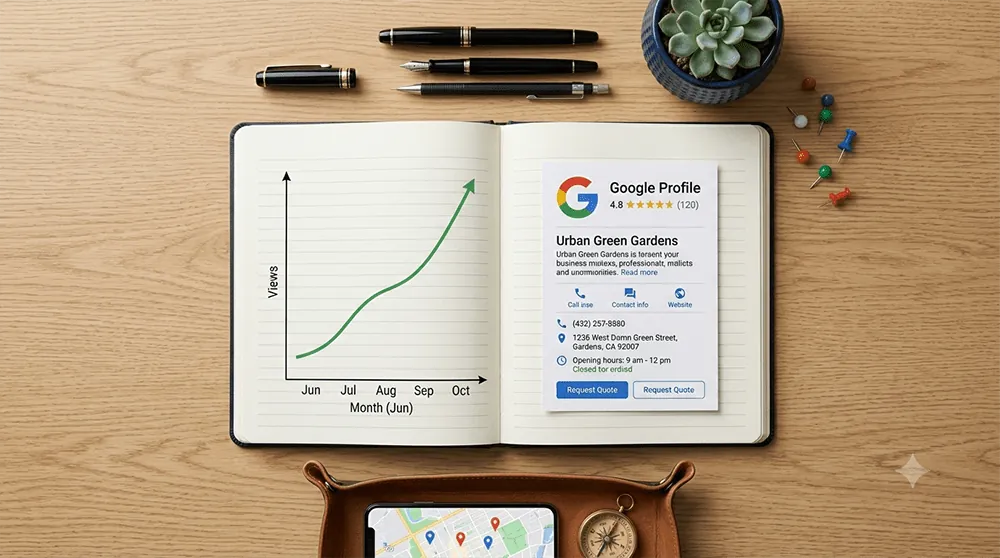
To measure the effectiveness of your local SEO strategy, several tools are essential. Google Business Profile Insights, available from your Google Business Profile listing, gives you valuable data on your listing’s performance: number of views, clicks to your website, direction requests, phone calls generated.
This data lets you measure the concrete impact of your local optimisation.
Google Search Console gives you information on the queries that generate impressions and clicks to your website from search results, including local queries. Check this data regularly to identify the keywords you already rank well for and those that represent room for improvement.
Specialised SEO tools such as BrightLocal, Whitespark or Semrush offer features dedicated to local SEO tracking: local rank tracking, citation audits, competitor review analysis.
Local SEO audit: take stock regularly
A regular local SEO audit, ideally every quarter, lets you check the state of your local SEO, identify technical or editorial problems to fix and follow how your local pack rankings evolve against your competitors.
This audit should cover the following points: completeness and accuracy of your Google Business Profile listing, NAP consistency across all your online sources, quality and quantity of your customer reviews, presence and consistency in the main local directories, on-page optimisation of your website for local queries, and technical performance (loading speed, mobile friendliness).
Mistakes to avoid at all costs
Several common mistakes can harm your local SEO. Leaving your Google Business Profile listing incomplete or unverified is the first, and the most damaging. Ignoring negative reviews without replying sends a negative signal to future customers and to Google.
Using artificial keywords in your business name on Google Business Profile (for example “Jean Dupont Plumber Paris 15”) is a practice Google penalises.
Not updating your opening hours for public holidays or closure periods is a frequent mistake that frustrates customers and damages your reputation. Creating multiple Google Business Profile listings for the same business creates confusion and can hurt your local ranking.
Web Opteam: your local SEO agency
Our local SEO expertise
At Web Opteam, a Paris-based digital agency working remotely with clients in English and in French, we help businesses, craftspeople, shops and professionals grow their local online visibility. Our approach to local SEO is complete and structured: we cover every lever, from Google Business Profile optimisation, local content strategy, customer review management, citations and directories, to technical optimisation of the website and performance tracking.
Our team of SEO experts masters the specifics of local SEO in France: the relevant directories, the practices suited to different industries (restaurant, craftsperson, shop, liberal professions), and the regular changes to the Google Maps algorithm and the local pack.
Audit, strategy and tailored support
Our local SEO support starts with a full audit of your local online presence: analysis of your Google Business Profile listing, NAP consistency check, assessment of your customer reviews, analysis of your current local rankings and identification of improvement opportunities against your competitors.
Based on this audit, we build a tailored local SEO strategy with you, with measurable goals and a prioritised action plan. We then take charge of putting the optimisations in place (technical, editorial and reputation-related) and monitor the results regularly.
Local SEO training for your teams
Web Opteam also offers local SEO training so your teams can master the fundamentals of local SEO and manage their online presence themselves. The training covers Google Business Profile management, local content strategy, customer review management and the use of tracking tools.
To contact our team and get an audit of your local SEO, visit our website or use our contact form. We are here to help you attract new customers in your area, and keep them.
Local SEO is about being in the right place at the right time for the right customer
Local SEO is one of the most profitable investments a local business can make in its digital development. An optimised Google Business Profile listing, a locally well-ranked website, an active customer review strategy and a consistent presence in local directories can radically transform a business’s visibility in its area, and generate a steady flow of new, qualified customers.
Local SEO isn’t reserved for big companies with large marketing budgets. A craftsperson, a restaurant, a local shop or an SME can significantly improve their local visibility by applying the best practices described in this guide, with free tools like Google Business Profile and Google Search Console, and an investment of time rather than money.
And if you want support from an experienced SEO agency to speed up your local growth, the Web Opteam team is here. Get in touch: we have the expertise, the tools and the knowledge of the French local market to make your business the reference in your sector, in your town.