Long-tail keywords in SEO: the strategy that pays off when you aim smaller… but more precisely
“Running shoes”. A search term that makes every online shop dream. Except that between the industry giants, the heavily optimised marketplaces and the media sites lurking in the background, it’s hard to find a place. So should you give up? Not at all.
What if the real El Dorado of SEO were hiding in… discretion? In the less visible but ultra-targeted searches? The ones we call the long tail.
Less well known, searched less often, but far more precise, these phrases are a gold mine for anyone who knows how to spot and use them.
In this article, we’re going to:
- Define what the long tail is and where it comes from,
- Understand why it’s so powerful in SEO (and beyond!),
- Learn how to find the right long-tail keywords,
- Look at concrete examples,
- And explain how to use it to boost your traffic… without blowing your budget or your sanity.
Right, off we go into the fascinating world of the long tail!
What are long-tail keywords in SEO?
A clear, visual definition of the long tail
The long tail (or long tail keywords, for those who run on technical English) refers to all the very specific search queries that are rarely typed individually but are extremely numerous. Taken one by one, they seem anecdotal. But put end to end, they generate a considerable volume of traffic, often far greater than that of generic queries.
With quality content writing and good semantic optimisation, you’re on to a winner.
Picture an immense queue of internet users: at the front, 100 people are shouting “running shoes”. Behind them, 10,000 people are each saying, in a low voice:
- “waterproof women’s trail running shoes”
- “running trainers with heel cushioning for flat feet”
- “men’s summer road running shoes for 10 km, for overpronators”
- …
These queries may only get 30 to 100 searches a month each, but if you cover 300 or 500 different ones, the combined effect is far more powerful than a single, ultra-competitive “star” keyword.
Put another way: it’s not the 10 star keywords that generate the most organic traffic, but the thousands of highly targeted niche queries that capture the real wealth of the web.
And the bonus? These queries are less competitive, more precise, and often tied to a very strong purchase or conversion intent (more on that below).
Where does the term “long tail” come from?
The term “long tail” was popularised by Chris Anderson, a journalist and entrepreneur, in an article published in Wired in 2004, then developed in his book The Long Tail: Why the Future of Business is Selling Less of More.
Anderson sets out a simple but visionary principle:
In the digital world, success doesn’t rest only on a few “best-selling” products, but also – and above all – on the sum of a multitude of niche products. These “small” pieces of content, less popular individually, become extremely effective once they’re added together.
Take Amazon as an example:
- The best-selling books make up only a tiny share of total sales.
- Most purchases come from thousands of lesser-known books, ordered regularly by very specific audiences.
And in SEO, it’s the same thing:
- Instead of trying to rank #1 for “shoes”, an ultra-competitive query,
- You aim for “women’s waterproof hiking shoes Vibram sole size 6”.
That keyword won’t flatter your ego, but it might make your phone beep with an order. The web isn’t a blockbuster. It’s a giant library where the niche shelves often earn far more than the shop windows.
Long tail and conversion intent: a (very) profitable correlation
One of the most powerful arguments for a long-tail strategy is its direct impact on conversions. And for good reason: the more precise a query, the stronger the user’s intent. Using semantic cocoons lets you target the real long-tail keywords with a strong intent to convert.
The intent behind the search: what the user really wants
Take two example queries:
- “Sports shoes”.
→ Vague intent: running? trainers? men’s or women’s? What for? - “Women’s running shoes for muddy terrain, for overpronators, size 7”.
→ Crystal-clear intent: the person knows what they want and is probably ready to buy.
The longer a query, the more contextual it is, and often it’s tied to an advanced stage of the buying journey: comparison, final selection or an imminent purchase.
A simple equation: precision = conversion
On the long tail, you don’t reach the curious. You reach people who are ready to act.
- They’ve identified their need.
- They’ve refined their search.
- They’re waiting for a clear, tailored answer, perhaps a specific product page or service.
The result: the conversion rate is much higher on this type of query than on generic keywords.
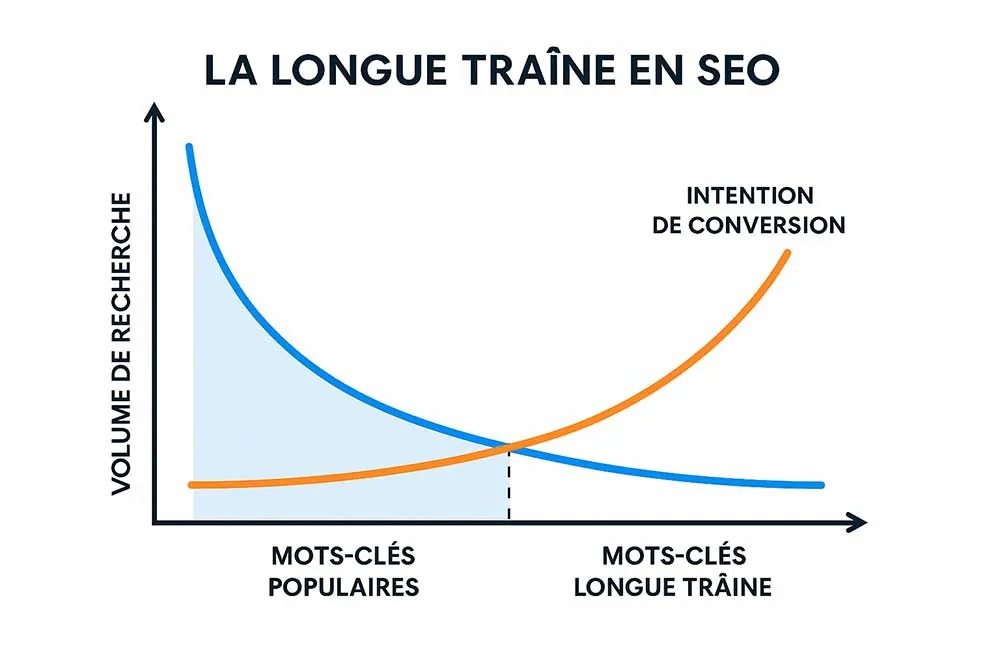
The famous double curve (see the image above) illustrates this perfectly:
- The blue curve (search volume) falls along the long tail,
- While the orange curve (conversion intent) climbs.
In other words: the further you go towards long queries, the less often they’re typed, but the more profitable they are.
Why is the long tail so powerful?
If the long tail appeals so much to SEO experts, it’s not a fad or a niche trick for small budgets. No. It’s because it rests on a relentless mathematical logic, combined with a fine reading of how internet users behave. It’s a less visible strategy, but a remarkably effective one.
Low volumes… but massive cumulative SEO traffic
At first glance, a query like “how to choose a CRM for a small estate agency” (≈30 searches/month) doesn’t look very sexy.
But multiply that by 300 similar queries:
- “CRM for a freelance in construction”
- “free CRM for a charity”
- “simple CRM for a small local communications agency”
- “cloud CRM for a two-person accounting firm”
And there you are: you’ve just opened the door to 10,000 monthly searches, all highly targeted.
The magic of the long tail is the cumulative leverage effect. Individually, each query looks marginal. Together, they form a steady flow of qualified visitors.
And unlike ultra-competitive generic keywords that demand huge resources, the long tail lets you generate lasting, scalable… and affordable SEO traffic.
Highly qualified traffic (ready to convert) thanks to long-tail SEO
People who type long-tail queries know what they want. They’re not there to browse.
Take this search: “waterproof trail shoes Vibram sole size 9 men’s”. That’s a long way from the vague “men’s sports shoes”. Here:
- The product type is defined (trail shoes),
- The use is clear (waterproof → specific weather conditions),
- The technical detail is advanced (Vibram sole),
- The size is precise (9),
- The gender is mentioned.
The result: this person isn’t comparing. They’re looking to buy.
The long tail aligns your content with strong purchase intent, which gives you a conversion rate that’s often higher than for general queries. By analysing People also ask queries, you can quickly find qualified content ideas to work these long-tail phrases.
And on the UX side? It’s a joy. You give the user exactly the answer they’re looking for, without making them scroll or hesitate.
Less competition in the long tail = more chance to rank
On a query like “CRM”, you’re up against:
- Salesforce,
- HubSpot,
- Pipedrive,
- SaaS comparison sites,
- B2B directories,
- And dozens of media sites.
Needless to say, without a site packed with backlinks, brand awareness and an SEO/PPC budget, you’ll be stuck on page 6 (the one nobody visits).
By contrast, for “simple CRM for an osteopath’s practice”, the competition is often:
- Weak,
- Poorly optimised,
- Or simply non-existent.
The result? Even with a modest site, well-crafted content and a bit of patience, you can reach the first page of Google… and stay there.
And that’s qualified, stable, free traffic.
The long tail is within reach of small budgets too!
The long tail is a bit like the SEO underdog’s revenge.
You don’t have:
- £8,000 to spend on backlinks?
- 8 full-time writers?
- A domain authority of 80/100?
No problem.
You can still:
- Identify niche queries with free or inexpensive tools,
- Create targeted content at your own pace,
- Rank for queries the big sites ignore because they’re deemed “not profitable enough”.
And that’s exactly where you win: where the big players don’t go, you can thrive.
It’s a lasting, scalable strategy, ideally suited to SMEs, freelancers, niche online retailers, agencies…
How do you identify long-tail keywords?
Before throwing yourself at SEO tools like a developer at Stack Overflow, go back to the essence of a Google search: an intent, a need, a question.
Finding long-tail keywords isn’t just a matter of picking from a list of suggestions. It’s a job of observation, of user logic… and a little marketing flair.
Think like your user: the basis of any good long-tail strategy
Before you fire up your SEMrush, grab a coffee, close your analytics tab… and get inside your target’s head.
Ask yourself these key questions:
- What is my customer really looking for?
A product? A solution? Advice? A confirmation?
- How do they phrase their search in real life?
In simple words? As a question? Rather “free quote software for sole traders” or “cheap freelance management tool”?
- Where are they in the user journey?
Is it a general information search (top of funnel), a comparison search (middle), or a transactional search (bottom)?
- What problems, obstacles or desires lie behind their search?
Examples:
- “running shoes for flat feet” → pain, comfort
- “how to choose travel insurance for the United States” → fear, safety, cost
Web Opteam tip: read forums, Facebook groups, Reddit, customer reviews or the FAQs on competitors’ sites. They’re gold mines of real user language.
That’s the long-tail mindset: think in life scenarios, not raw keywords.
Use Google’s suggestions: the long tail’s free playground
You don’t need to pay to understand how people type their searches. Google whispers the answer. Literally.
Type any keyword into the search bar and look at:
- The autosuggestions (what appears as you type)
- The related searches (at the very bottom of the results)
Example with “gluten-free recipe”:
- “easy gluten-free recipe”
- “gluten-free dairy-free recipe”
- “quick gluten-free recipe for kids”
- “gluten-free recipe slow cooker”
Each suggestion is a potential long-tail query, because it combines several criteria: a specific need, a tool, a constraint, a target.
Pro tip: type a query and add a letter after it (“gluten-free recipe a”, “gluten-free recipe b”, etc.) → snowball effect guaranteed.
The must-have long-tail tools (and their strengths)
Here’s a selection of tools to bring the long tail’s gems to the surface.
1. Google Keyword Planner
- Advantage: reliable, because it’s Google data.
- Limit: gives fuzzy volume ranges (“10–100”, “100–1K”…), not always very granular.
- Ideal for: checking a keyword’s minimum interest or exploring topics.
2. AnswerThePublic
-
Generates a mind map of the questions asked around a keyword.
-
Very useful for capturing internet users’ natural language.
-
E.g. around “lavender essential oil”, you’ll find:
- “when to use lavender essential oil”
- “lavender essential oil for baby sleep”
3. Ubersuggest (Neil Patel)
- Simple interface, clear data.
- Offers volumes, CPC, and ideas close to the long tail.
- Ideal for getting started or validating a keyword.
4. SEMrush / Ahrefs
- The Rolls-Royces of SEO.
- Access to billions of queries, links between keywords, content suggestions, competition, SERPs, and more.
- Expensive, but very profitable for an advanced content strategy.
5. Google Search Console (GSC)
- Your site already gets traffic? Perfect.
- Look at the queries that bring you clicks and impressions.
- You’ll be surprised how many long-tail keywords bring you traffic… without you ever having planned for it.
Web Opteam advice: analyse the queries that show your page in position 8–15. They’re perfect opportunities to optimise and climb into the top 3.
The voice search boom: the long tail par excellence
Siri, Alexa, Google Assistant… voice assistants are radically changing how we search the web. And guess what? They love the long tail.
Why? Because people talk to assistants, they don’t type. Type: “cheap running shoes”. Now say out loud: “what are the best not-too-expensive running shoes for a beginner?”
The difference is striking: longer, more natural, more precise.
And if you optimise your content to answer these naturally phrased questions, you:
- Target voice search (which is growing fast),
- Gain relevance on mobile,
- Improve your chances of landing featured snippets.
The magic format for voice long tail: FAQs, question-style H2s, concise and structured content.
The advantages (and limits) of a long-tail strategy
Like any marketing strategy, the long tail isn’t a magic wand, but it’s a powerful lever when used well. It shines through its many advantages, but it also comes with a few constraints. Here’s an objective look at the gains you can expect… and the effort you’ll need to put in.
The concrete benefits of the long tail: a smart, lasting, profitable strategy
1. Easier to rank: less competition, more results
This is one of the main arguments: long-tail queries are often neglected by the big players. Why? Because they’re less “sexy” in a report, or too specific for generalist strategies.
The consequence? Fewer competing pages on Google, so it’s easier to climb into the top 10, even the top 3, without an ultra-powerful site.
You can start performing in SEO with:
- A well-structured site,
- Quality content,
- And a bit of patience.
No need for backlinks by the bucketload or a DA of 80: the long tail opens the door to challengers.
2. Higher conversion rate: visitors who know what they want
A visitor typing “best organic waterproof mascara for sensitive eyes” doesn’t want to read a philosophical blog post about cosmetics.
They want to buy. Now.
That’s the long tail: bottom-of-funnel queries, very close to conversion:
- Purchase,
- Quote request,
- Appointment booking,
- Sign-up for a training course.
The traffic is smaller… but much more profitable.
3. Granular targeting: you attract exactly the right audience
A long-tail strategy lets you address very precise personas.
You can write content for:
- “busy mum looking for quick veggie recipes for kids”,
- “craftsperson looking for online invoicing software compatible with Swiss QR codes”,
- “recent graduate who wants to learn UX design remotely in under 3 months”.
And the bonus? By targeting finely, you speak your audience’s language, you gain engagement, and you strengthen your credibility.
In SEO as in dating: it’s better to be 100% right for 100 people than half right for 10,000.
4. SEO stability: less volatility, more durability
Generic queries are volatile:
- A Google update,
- A new competing page,
- A change in the SERP… and you lose 50% of your traffic.
Long-tail queries are less exposed to sudden changes:
- Their volume is stable over time,
- Competition there evolves slowly,
- You build lasting positions.
In other words, it’s SEO that lasts, not buzz that explodes and fades.
The drawbacks of the long tail: it isn’t magic, you have to work
1. A substantial editorial effort: multiplying pages without losing quality
The long tail rests on a simple principle: one query = one answer = one page.
To capture 200 long-tail queries:
- You need 200 well-thought-out pages,
- Structured, optimised, useful,
- And not duplicated or spammy.
It’s an investment in content production. It takes:
- Time,
- An editorial team or an outsourced strategy,
- A coherent schedule.
The good news? It’s a lasting asset. Every page is an open door into Google, 24/7.
2. Indirect visibility: fewer “vanity keywords”
Let’s be honest: if you dream of ranking in the top 3 for “SEO training”, “running shoes” or “CRM”, the long tail won’t take you there directly.
You’ll shine on queries that are:
- Searched less,
- Less visible on competitors’ SEO dashboards,
- But highly relevant to your audience.
The result: you get traffic… but not necessarily immediate perceived fame.
It’s not an ego strategy, it’s an efficiency strategy.
3. Not suited to every business model
Some business models don’t lend themselves well to it:
- Ultra-luxury or premium: too much granularity can harm the image.
- Pure awareness or branding: the long tail won’t make you famous.
- Very narrow offers: if you sell a single product or service, you’ll soon be going round in circles.
In these cases, it may be wiser to bet on flagship content or high-volume queries combined with a PPC strategy.
In short:
The long tail is surgical, profitable, lasting SEO. But it takes method, rigour, and a bit of keyboard sweat.
How do you use the long tail effectively in SEO?
Structure your site with content clusters
Work by theme: a “pillar” article on a broad topic, surrounded by more targeted pieces (the famous long tails).
Example:
-
Pillar: “How to choose your running shoes”
-
Long tail:
- “neutral gait women’s running shoes”
- “best running shoes for marathons”
Write ultra-targeted content
- One long-tail keyword = one dedicated page.
- Clear structure: Hn tags, flowing text, the right length.
- Think about the precise questions your personas ask themselves.
Optimise on-page SEO intelligently
-
Use long-tail keywords in:
- The title (H1 tag)
- The URL
- The meta description
- The subheadings (H2/H3)
The text (naturally, always)
Measure, adjust the long tail, repeat
Use Google Search Console to see the queries that already bring you traffic, and build on them.
Look at click-through rates, average positions, the pages that perform… and adjust your strategy.
The long tail: a formidable ally for local SEO
In a local SEO strategy, the goal is to capture location-based searches, often phrased in a very specific way. And guess what? These queries are… long tails in disguise.
The combination of precise intent + location gives rise to thousands of low-volume searches… with very high conversion potential.
Local queries = long-tail queries
Take two examples:
- “hair salon” → generic query (and ultra-competitive)
- “organic face-shape hairdresser open on Mondays in Lyon Croix-Rousse” → local long-tail query
The second contains:
- An explicit intent (organic, face-shape cut),
- A time constraint (open on Mondays),
- A precise location (a targeted district of Lyon).
And above all: it’s exactly what a mobile user types on their phone when they have an immediate need.
Local is the long tail in the service of action
Geolocated long-tail queries activate:
- Proximity search, often on the move,
- Immediate-service search, with strong intent to act,
- Ultra-contextual search, typical of the bottom of the funnel.
In other words, these internet users aren’t looking for a brand, they’re looking for a concrete solution here and now.
And that’s where you come in.
Examples of local SEO + long-tail queries
Here are typical examples mixing local SEO and the long tail:
| Generic query | Long-tail query |
| “artisan bakery” | “organic bakery open Sunday morning in Nantes city centre” |
| “osteopath” | “sports osteopath, insurance-approved, in Marseille Prado” |
| “vegetarian restaurant” | “gluten-free vegetarian restaurant with a terrace in Toulouse” |
| “yoga class” | “beginner vinyasa yoga class in the evening in Lille Vauban” |
| “wedding photographer” | “boho outdoor wedding photographer in the Vaucluse” |
Each of these queries may generate little traffic on its own, but over a year, and across several close variants, the combined volume becomes significant – and above all, highly qualified.
Why does Google love these long-tail queries?
- They’re ultra-targeted, so Google can offer very relevant results.
- They reflect clear local intents, which activates the local SERP (Google Maps, Local Pack, etc.).
- They encourage micro-conversions: calls, directions, bookings, clicks on your Google Business Profile.
How do you make the most of local long tail?
A few concrete tips:
-
Optimise your Google Business Profile (formerly Google My Business) with:
- long-tail keywords in the description,
- precise categories,
- FAQs with local phrasing (“Are you open on Sundays in Lyon?”).
-
Create local pages:
- By city or district (e.g. “Wellness massage in Bordeaux Bastide”)
- By specific need (e.g. “Sports massage after a marathon in Paris”)
-
Use customer reviews to pick up geolocated long-tail vocabulary (and feed your “invisible” SEO).
-
Write articles or landing pages combining need + location:
- “How do you find an osteopath specialising in postpartum care in Strasbourg?”
- “Top 5 vegan restaurants with a terrace in Montpellier in 2024”
Local SEO + long tail = a winning combo
If you want to boost your local traffic, fill your diary, or dominate your neighbourhood on Google Maps, don’t bet everything on generic queries.
Target the real local intents, the ones phrased precisely, which reflect a strong need in a concrete geographic context.
That’s where the long tail in local SEO becomes your secret weapon.
Long tail and generative SEO (GEO): a duo made for the AI era
SEO is in the middle of a shift. With the arrival of generative search engines like Google SGE, Bing Copilot or Perplexity, the results landscape is changing: AI-written answers, rich extracts, automatic summaries…
And in this new game, the long tail is more of a strategic weapon than ever.
The principle of GEO (Generative Engine Optimization)
GEO means optimising your content not only for Google’s classic ranking, but so that it’s included in answers generated by artificial intelligence.
In other words:
- You want your content to be cited, summarised, used in AI answer blocks.
- You want AI-generated answers to draw on your site, with the source link included.
And here’s where it gets interesting: generative engines feed heavily on… long-tail content.
Why do AIs favour long-tail content?
-
Generative queries are longer, conversational, contextual.
→ Typically… long-tail queries!Examples:
- “What’s the best home insurance for a student tenant in a shared flat?”
- “What are the benefits of an infrared sauna for chronic back pain?”
-
AIs look for detailed, precise, well-structured content.
→ Which is what you naturally produce in a long-tail strategy! -
Users ask complex, multi-criteria questions that only very targeted pages (so often long-tail ones) handle properly.
Clearly, the very structure of long-tail content is aligned with how generative AIs work.
Long tail = better visibility in AI answers
Generative models try to:
- Find the most complete answer,
- With the least possible ambiguity,
- And rely on credible, well-contextualised sources.
The result:
- Pages that clearly answer a specific query are more likely to be cited or included in the AI’s answer.
- Well-written, well-structured niche content stands out far better than ultra-broad generalist content.
And that’s exactly what a long-tail-based SEO strategy produces.
A few GEO-friendly best practices… that overlap with the long tail
-
Clear structure (H1, H2, lists) to help the AI summarise
-
Explicit answers to precise questions at the start of a paragraph
-
Content with strong informational intent, well sourced, well contextualised
-
An FAQ at the bottom of the article to handle sub-queries
-
Natural, conversational headings, close to voice or AI phrasing.
Example:
- Bad: Our advice on insurance
- Good: Which insurance should you choose as a student in a shared flat?
Long tail and generative AI: towards a new logic of visibility
In the old world of SEO, you fought to get into the 10 blue links.
In the world of GEO, you fight to be the source the AI uses in its synthesised answer.
And to do that, you need to:
- Produce useful, expert, targeted, well-written content,
- Optimised not for volume, but for contextual relevance,
Exactly what a well-run long-tail strategy gives you.
In short: GEO + long tail = tomorrow’s visibility
AI engines like long, specific, natural queries. They favour ultra-targeted, well-documented, well-structured content. Tomorrow’s SEO is won in niches, not in generalities. Betting on the long tail today means positioning yourself for tomorrow’s SEO… the kind that will be read, understood and summarised by AIs.
Concrete examples of long-tail queries
| Short query (short tail) | Long-tail query |
| “running shoes” | “women’s mountain trail running shoes with cushioning” |
| “crm” | “free crm for a non-profit organisation” |
| “chocolate cake recipe” | “moist chocolate cake recipe without eggs or milk” |
By sector:
- Cosmetics: “best anti-ageing serum for combination skin over 40”
- Training: “accredited online UX course with mentoring”
- Travel: “3-day nature break ideas near Paris without a car”
Case study: how an online shop boosted its traffic by 40% with the long tail
Context: An organic natural-products shop. Little brand awareness, limited budget.
Problem: Too much competition on generic queries (“organic shampoo”, “natural toothpaste”).
Strategy:
- Creation of 80 pages optimised for ultra-targeted queries:
- “sulphate-free organic shampoo for curly hair”
- “fluoride-free natural toothpaste for children”
- Setting up smart internal linking
- Human SEO copywriting, built-in FAQs, mobile optimisation
Results after 6 months:
- +40% organic traffic
- +25% e-commerce conversion
- Better retention on the site
65% of visitors came from long-tail queries
Long-tail SEO is the art of preferring the back roads to the traffic motorways.
It isn’t the flashiest strategy, but it’s one of the most effective when you want to build lasting, targeted, high-performing search visibility.
To remember:
- It requires knowing your personas well,
- It rests on creating useful, targeted content,
- It makes it easier to rank on Google,
- It generates more qualified traffic, so it’s more profitable.
So, ready to deploy an army of long-tail content and win the search war? At Web Opteam, we can even help you with it (really).
And because we’re ever so kind, here’s a handy bonus memo so you don’t get your wires crossed when working on your site’s long tail:
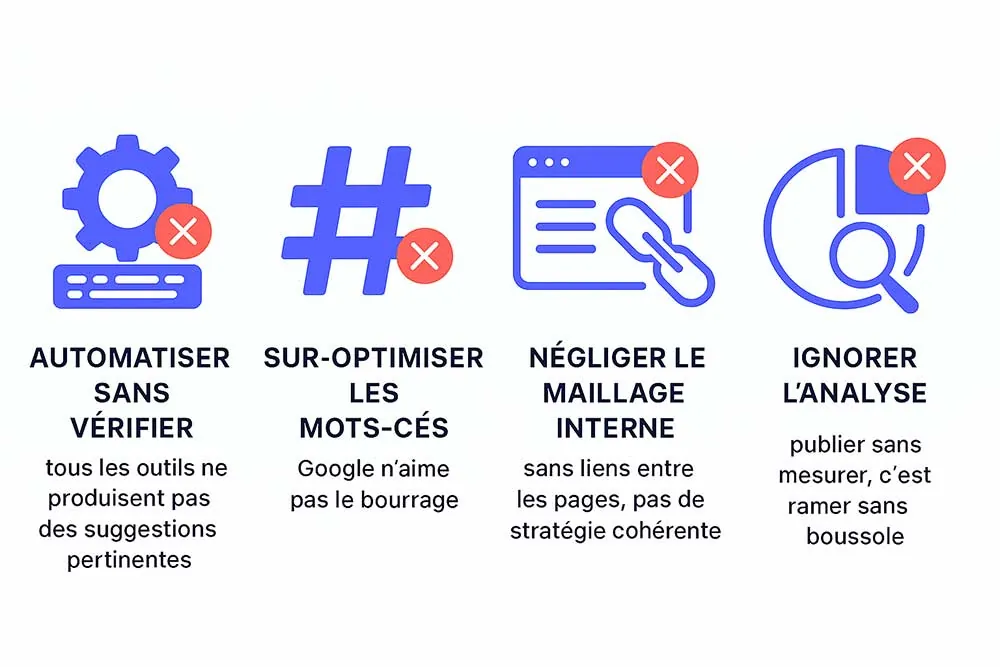
Bonus: the classic mistakes to avoid with the long tail